

World · Space
Three Tonnes of Food, Fuel and Supplies: Russia’s Progress 97 Docks With the Space Station
Two days after lifting off from Kazakhstan, an uncrewed Russian freighter chased down the International Space Station and locked onto its Rassvet module at 7:08 in the morning. NASA’s cameras caught every second of the silent rendezvous — and the pictures are spectacular.
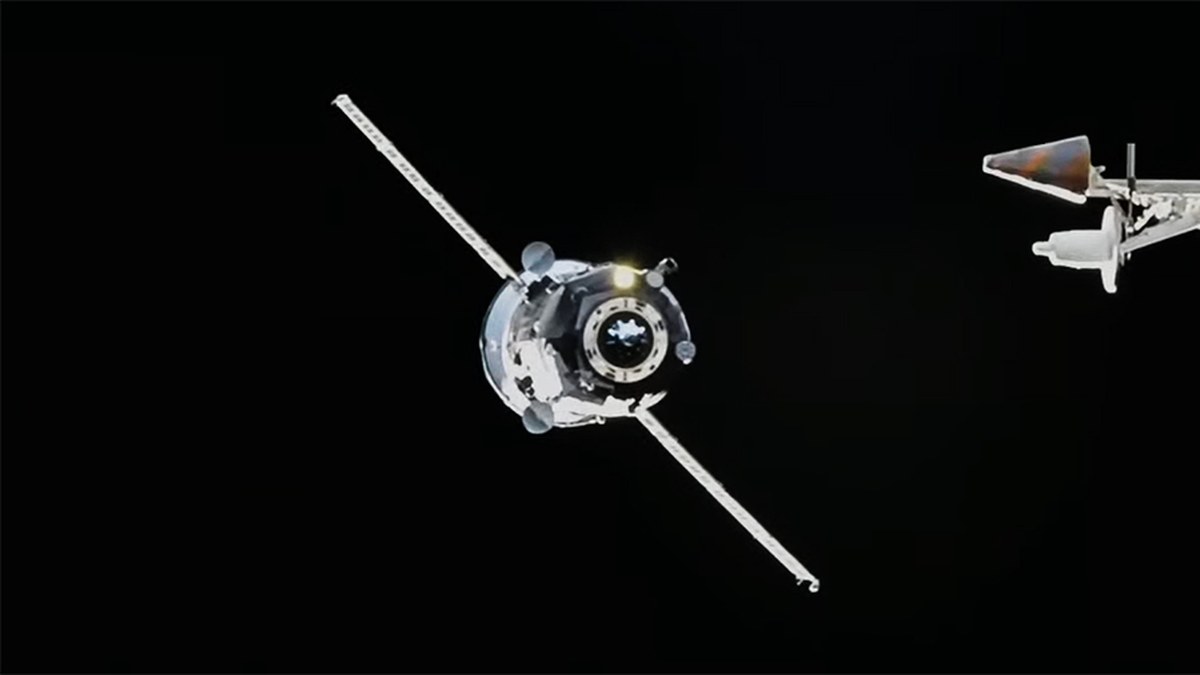
The delivery arrived without a sound. On the morning of 26 November 2026, Russia’s Progress 97 cargo spacecraft closed the final metres to the International Space Station and docked with the Rassvet module at 7:08 AM EST, completing a two-day journey from a launch pad in Kazakhstan to a port circling high above the Earth. There was no crew aboard and no pilot at the controls — just an automated freighter flying itself into the most precise parking job in the world.
Progress 97 had lifted off two days earlier, on 24 November, aboard a Soyuz rocket from Kazakhstan. While the station circled the planet, the freighter spent those two days patiently adjusting its orbit — climbing, phasing and closing the gap — until it was gliding in formation with the outpost, ready for the final approach. NASA’s cameras followed the entire sequence: the spacecraft crossing above the Earth, the slow and deliberate approach, and the moment of contact with Rassvet. It is footage that makes a routine logistics run look like a ballet.
In the freighter’s hold were approximately three tons of food, fuel and essential supplies, bound for the Expedition 75 crew living and working aboard the station. Every item matters up there. The station cannot manufacture what it consumes, so its crews depend entirely on this rhythm of arrivals: meals and equipment to keep daily life and science running, and fuel that helps the outpost hold its orbit against the constant, gentle drag of the upper atmosphere. A missed delivery would not be an inconvenience; it would be a countdown.
“No crew, no pilot, no fanfare — just three tonnes of food, fuel and supplies, delivered on schedule to a port named “dawn”.
The port Progress 97 used carries one of the prettiest names on the station. Rassvet — Russian for “dawn” — is also known as the Mini-Research Module 1. It has been part of the station since 2010, when the space shuttle Atlantis carried it into orbit and it was attached to the Earth-facing port of the Zarya module. Rassvet works mainly as cargo storage and as a docking port for visiting Russian spacecraft, which is exactly the job it performed on Wednesday morning: receiving a freighter, as it has done for fifteen years.
The Progress itself is the oldest workhorse in the business. Russia’s uncrewed cargo line has been flying since 1978, supplying a succession of space stations long before the ISS existed, and its modern Progress MS version still rides to orbit on the Soyuz rocket. The philosophy has never changed: no crew, no ceremony, just haul. When a Progress finishes its stay, it is typically loaded with the station’s rubbish and sent to burn up in the atmosphere — a delivery van that is also the garbage truck.
What carried this particular mission around the world was the imagery. Reports built on NASA’s footage — including NDTV Profit’s coverage of the docking — showed the spacecraft orbiting the Earth, approaching the station and completing its precision docking in clear, lingering shots. It was a reminder that some of the most dramatic engineering humans perform happens almost in silence, on autopilot, with nobody’s hands on the controls.
For the Expedition 75 crew, the arrival means fresh supplies, full stores and breathing room for the months ahead. For the rest of us, it is a small lesson in how the space station actually survives: not through single heroic missions, but through an unbroken supply line of freighters arriving on schedule, year after year. Progress 97’s docking was, on paper, routine. But every routine docking is a small miracle of timing — two machines, launched from different plans and different days, meeting exactly where they were supposed to meet, at a port named dawn.
Based on reporting and footage by NASA and NDTV Profit. Watch the report on YouTube.
For more stories like this, subscribe to STORIX with FAYS on YouTube and visit our Videos gallery.
Comments