

News
Shut Out by America, China Built Its Own Home in Space
The International Space Station has welcomed astronauts from dozens of countries — but never one from China. Locked out first by politics, then by law, Beijing chose the only road left: a station of its own. This is how Tiangong, the “Heavenly Palace” that received Pakistan’s Zeeshan Ali this week, came to circle the Earth.
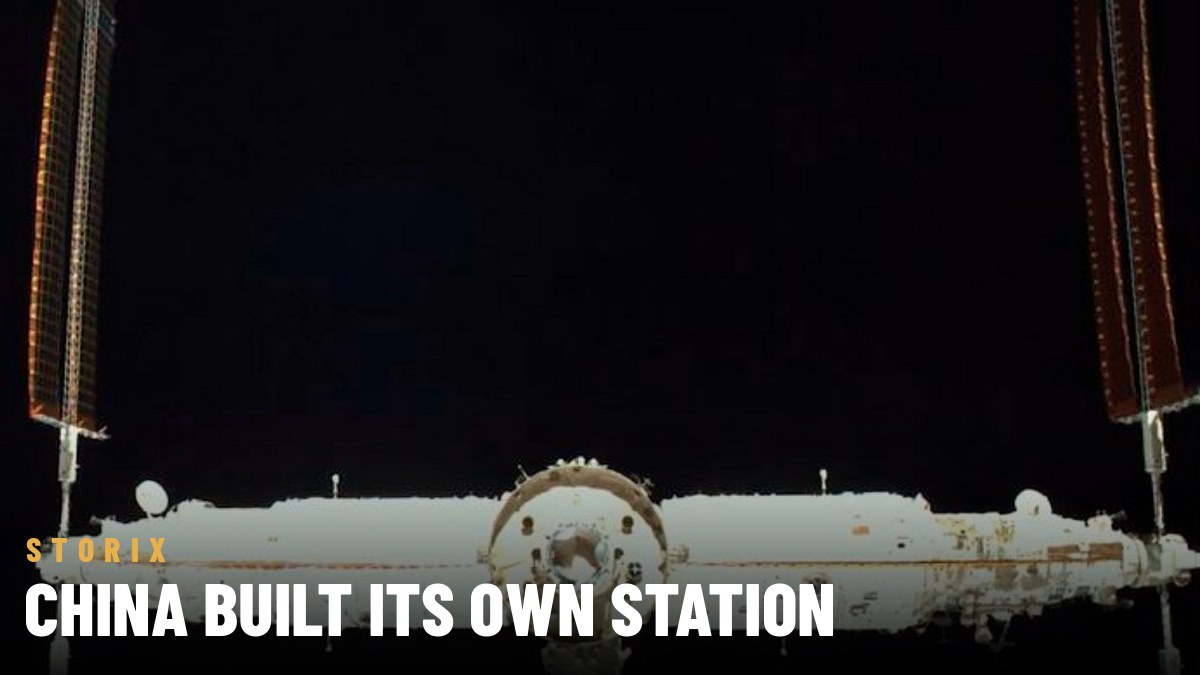
On Tuesday, a Pakistan Air Force pilot floated through a hatch 400 kilometres above the Earth and into the history books — the first foreign astronaut ever to board China’s Tiangong space station. But the station he entered exists because the world’s existing space station was closed to his hosts. Since Yuri Gagarin’s flight in 1961, citizens of around 50 countries have travelled to space — yet only three nations, Russia, the United States and China, have ever sent people up on spacecraft of their own. Everyone else has flown as somebody’s guest. China tried to be a guest too. It was never invited.
A partnership with no seat for China
The International Space Station was put together from 1998 by five partners: the United States, Russia, Europe, Japan and Canada. China made clear it wanted to take part — and Washington’s answer, shaped by fears that shared technology would feed a space programme overseen by the People’s Liberation Army, was always no. To this day, no Chinese astronaut has ever set foot aboard the ISS.
The law that made it permanent
In April 2011, US Congressman Frank Wolf wrote that exclusion into law. The Wolf Amendment, attached to a federal spending bill, forbids NASA and the White House science office from spending money on bilateral cooperation with China — or even hosting official Chinese visitors — unless the FBI first certifies there is no risk of technology leaking and Congress is notified. The clause has been renewed in spending bills every year since.
“Denied a seat at the table, China built its own — four hundred kilometres above the Earth.
First, learn to fly alone
The self-reliant road began long before the law. China’s crewed programme, Project 921, was approved in 1992, and in October 2003 Yang Liwei’s Shenzhou-5 flight made China only the third country to launch its own astronaut. What China still lacked was station craft: keeping people alive in orbit for months, and docking two spacecraft travelling at some 28,000 kilometres an hour. So it rehearsed with two small laboratories, both named Tiangong — “Heavenly Palace”. Tiangong-1, launched in September 2011, received the uncrewed Shenzhou-8, which performed China’s first docking, then crewed visits by Shenzhou-9 in 2012 and Shenzhou-10 in 2013. Tiangong-2 followed in 2016; the Shenzhou-11 crew stayed 30 days, a national record at the time, and in 2017 the cargo ship Tianzhou-1 docked with it and refuelled it. Both laboratories were later brought down over the Pacific — Tiangong-1 in an uncontrolled re-entry in April 2018, Tiangong-2 in a planned one in July 2019.
The Heavenly Palace takes shape
The permanent station went up fast. Its core module, Tianhe — “Harmony of the Heavens” — rode a Long March 5B rocket from Wenchang on 29 April 2021. That June, the Shenzhou-12 crew moved in for 90 days, about three times longer than any Chinese mission before it. Two laboratory modules then completed the T-shaped outpost: Wentian on 24 July 2022 and Mengtian on 31 October 2022. The station, orbiting between roughly 350 and 450 kilometres above the Earth — about the same height as the ISS — has been continuously occupied since 2022, with crews of three rotating roughly every six months. Beijing plans to keep it crewed for at least a decade.
Two stations, two futures
The contrast is now hard to miss. The ISS, ageing and expensive to run, is scheduled to retire around 2030 and be brought down into the Pacific. Tiangong is young and growing — and once the ISS is gone, it may for a time be the only permanently crewed station in orbit. Nor is China stopping at Earth orbit: it aims to land its astronauts on the Moon before 2030, and is planning a lunar research station together with Russia — another table at which, under the Wolf Amendment, NASA cannot sit.
The door that exclusion built — now open
There is an irony at the centre of this story. The station China built because it was shut out has been designed, from early on, to let others in. Through a programme run with the United Nations, experiments from institutions in 17 countries were selected to fly aboard Tiangong. And this week came the most visible proof of all: Shenzhou-24 carried PAF pilot Muhammad Zeeshan Ali to the station on 25 November 2026, to work on experiments including joint Pakistan-China projects. Namira Salim became the first Pakistani in space on a suborbital Virgin Galactic flight in 2023; Ali is the first to reach orbit and board a station. For countries that will never receive an invitation from the old partnership, Tiangong is now a genuine second door into orbit — built, fittingly, by the country that was refused at the first one.
Sources: US Public Law 112-10 (the Wolf Amendment); CSIS Defense360; Space.com; China Manned Space Agency mission summaries; UNOOSA–CMSA experiment programme.
Read next: how Zeeshan Ali’s first hours aboard Tiangong unfolded, and why China gave a Pakistani pilot the seat. For more stories like this, subscribe to STORIX with FAYS on YouTube.
Comments