
News
Why China Put a Pakistani Astronaut Aboard Its Space Station
When Shenzhou-24 lifted off from Jiuquan on Tuesday morning, two of its three seats were expected. The third was not. In it sat a Pakistan Air Force fighter pilot — the first foreigner ever carried to China's Tiangong space station. Why did Beijing open a door it had kept shut since the station was built?
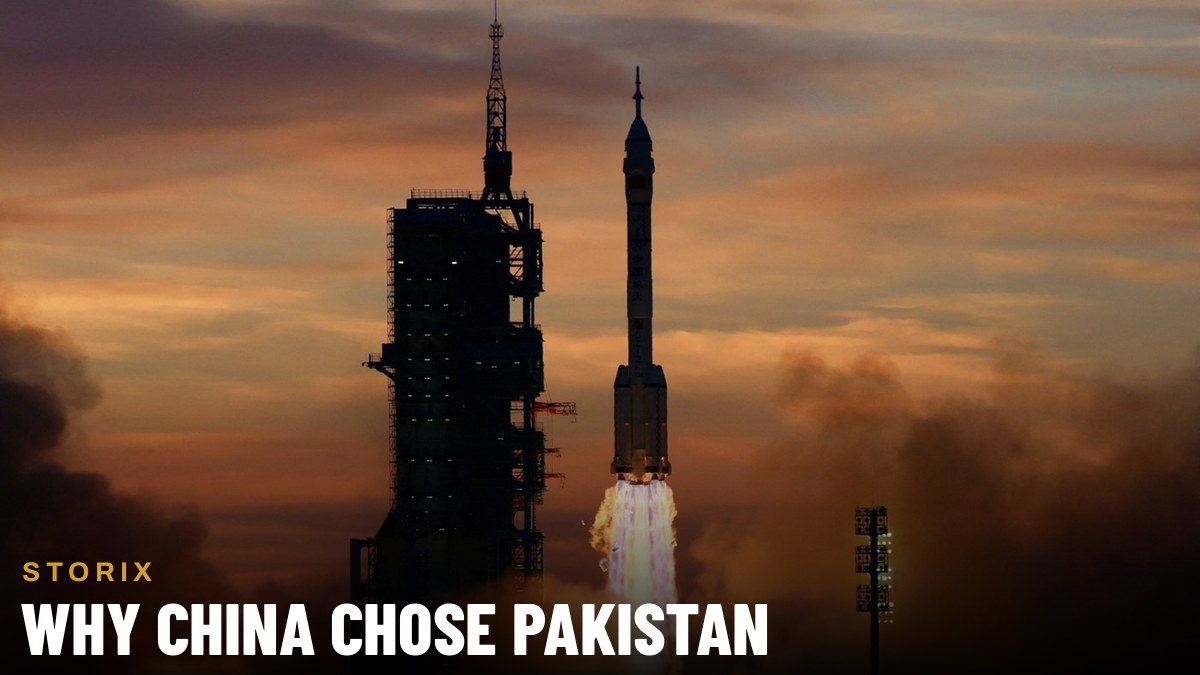
The launch itself, at 08:18 Beijing time on 25 November, went exactly to plan: a Long March-2F from Jiuquan, orbit in about ten minutes, a complete success. Commander Tang Hongbo and flight engineer Wu Yi are the kind of crew China has flown for years. The third man, payload specialist Muhammad Zeeshan Ali, is something new — a 40-year-old Pakistani fighter pilot, and the first astronaut from any other country to join a Chinese crewed mission.
A door that stayed shut — until now
Tiangong has been occupied, in rotation, since its core module went up — and every single person who has lived aboard it has been Chinese. China's crewed programme was built as a national project, run in the Chinese language, under Chinese procedures. So putting a foreign pilot through that system is not a small favour. Ali had to be trained to fly inside it — which is why the practical details of his preparation matter: he compressed a one-year training programme into seven months, and said the hardest part was not the centrifuge or the survival drills, but learning Mandarin, the language in which the entire mission is conducted.
It started with a signature in February 2025
This flight was arranged, not improvised. In February 2025, Pakistan's space agency SUPARCO and the China Manned Space Agency signed an agreement to fly a Pakistani astronaut on a Chinese mission. Two PAF pilots were selected for the programme: Ali, and Khurram Daud. That sequence — agreement first, selection second, flight third — is the clearest sign of what this is: not a one-off ride, but the first working result of a standing arrangement between the two space agencies.
What China gains
“I'm not flying for myself. I carry the name of Pakistan on my shoulder.
Read plainly, the flight is a signal about what Tiangong is for. A station that hosts another country's astronaut, runs that country's experiments and trains that country's pilots is presenting itself as an international research facility — a platform other nations can plan around, not just admire from the ground. Flying Ali demonstrates, in the most visible way possible, that the station's doors can open: that a partner country can send its own person, in its own flag patch, to do real work in orbit. For China, every successful mission of this kind also deepens its oldest partnership in the region, moving cooperation with Pakistan from satellites and launches into human spaceflight — the most demanding, and most symbolic, tier of all.
What Pakistan gains
For Pakistan, the return is concrete. Ali is not a passenger: as payload specialist he will take part in around 90 experiments during his week aboard, among them four joint Pakistan-China projects in biotechnology and materials science, including work with cyanobacteria. Pakistani science, in other words, is not just watching this mission — it is on the manifest. Pakistan also gains something harder to buy: a citizen who has been through a full astronaut training pipeline and flown, and a second selected pilot, Khurram Daud, behind him. SUPARCO was founded in 1961; for most of the decades since, a Pakistani in orbit was a slogan. It is now a training programme with a flight record.
What happens next
Ali will spend about a week aboard Tiangong and then return to Earth aboard the Shenzhou-23 spacecraft. At home, the reaction has already told its own story: President Asif Ali Zardari called the flight a "landmark achievement", and Prime Minister Shehbaz Sharif sent the crew his congratulations, saying Ali carried the hopes of millions with him. Planning Minister Ahsan Iqbal watched the launch in person in China.
The bigger question this flight leaves behind is whether Ali is an exception or a precedent. One foreign astronaut proves the door can open. Whether astronauts from other partner countries follow him through it will show how far China intends to take the idea of Tiangong as a shared station. Either way, the first name on that list is now written — and it is a Pakistani one.
Sources: Reuters, Dawn, Al Jazeera, Nature and Nikkei Asia reports, 24–25 November 2026.
For more stories like this, subscribe to STORIX with FAYS on YouTube and visit our Videos gallery.
Comments