
News
“Welcome to Tiangong”: Zeeshan Ali’s First Hours Aboard China’s Space Station — and the Interview That Explained Them
When the hatch of the Shenzhou-24 spacecraft opened inside China’s Tiangong space station on 25 November, Muhammad Zeeshan Ali became the first foreign astronaut ever welcomed aboard. Cameras caught the hugs, the speeches and the welcome cake — and on the ground in Beijing, an expert interview answered the questions everyone was asking.
Six months apart, one embrace
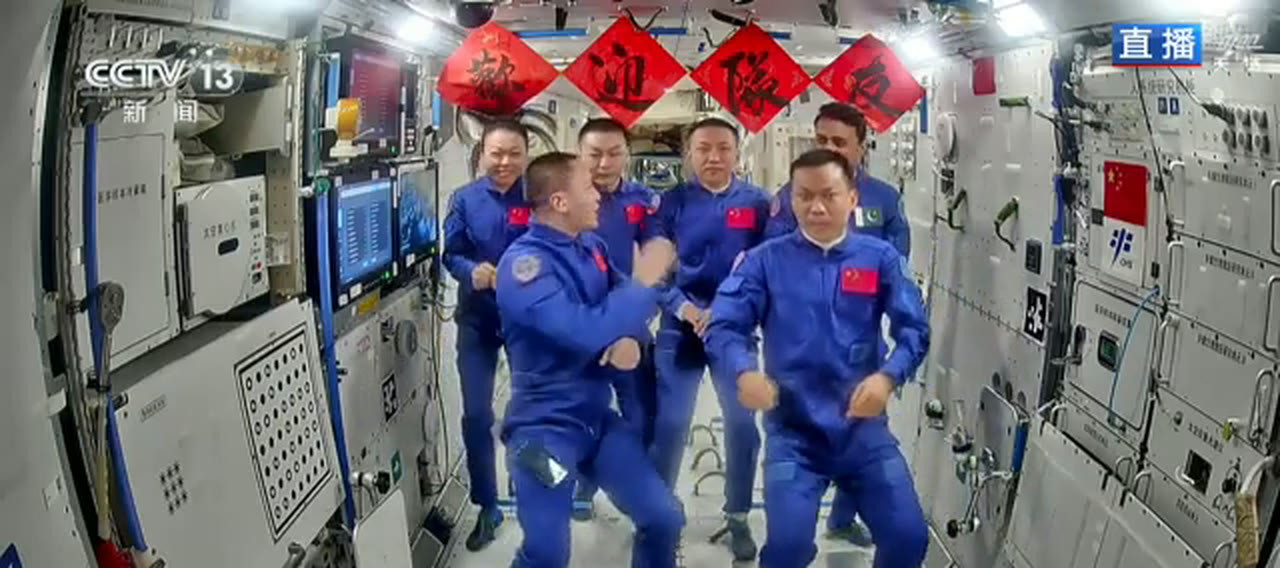
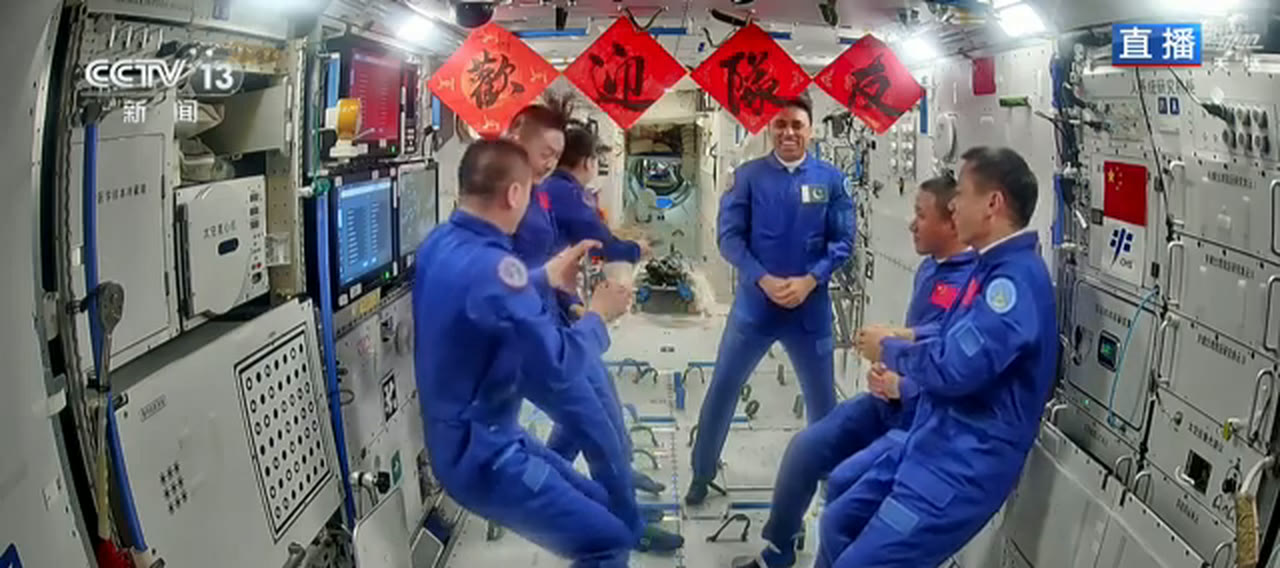
The Shenzhou-23 crew — commander Zhu Yangzhu, Zhang Zhiyuan and Li Jiaying — had been living and working aboard Tiangong for six months when the forward hatch opened. First through was Shenzhou-24 commander Tang Hongbo, on his third spaceflight. Then came the moment the broadcast had been building towards: Zeeshan Ali floated in, and the China Space Station welcomed a foreign astronaut for the first time in its history.
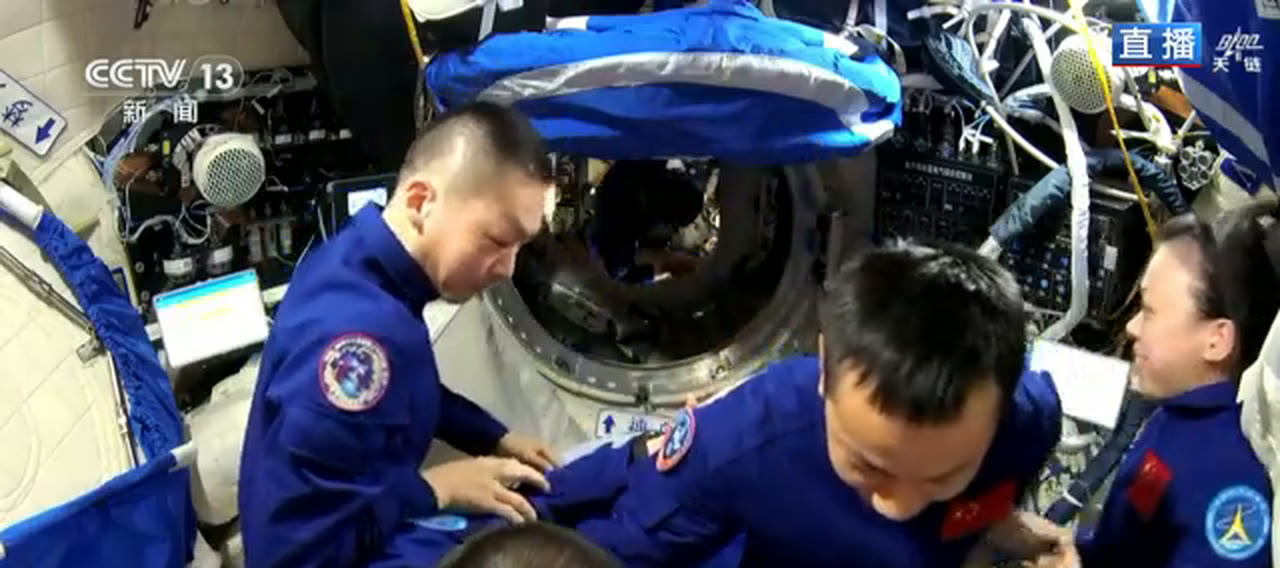
There was nothing stiff about the reunion. The two crews had trained together on the ground, and it showed — hugs, laughter and, in the words of the live commentary, a joy the audience “could feel through the screen”. Red welcome banners had been hung in the core module in advance, and the cabin had been tidied for the guests.
At a small welcome ceremony, each crew member spoke. Zhu Yangzhu noted that it was his second time welcoming Commander Tang in space, and congratulated Wu Yi and Ali on their first flights: “Both Wu Yi and Ali are on their first flights — congratulations on realising your dreams of spaceflight.” Tang Hongbo replied that it was his third time in space and his second time “coming home”: “Our space home feels very warm.”
Wu Yi, also on his first mission, said flying “with our Pakistani brothers” and witnessing the historic moment made him “very honoured and proud”.
Then Ali spoke — in Chinese, and, as the studio anchor later put it, “with a booming voice”:
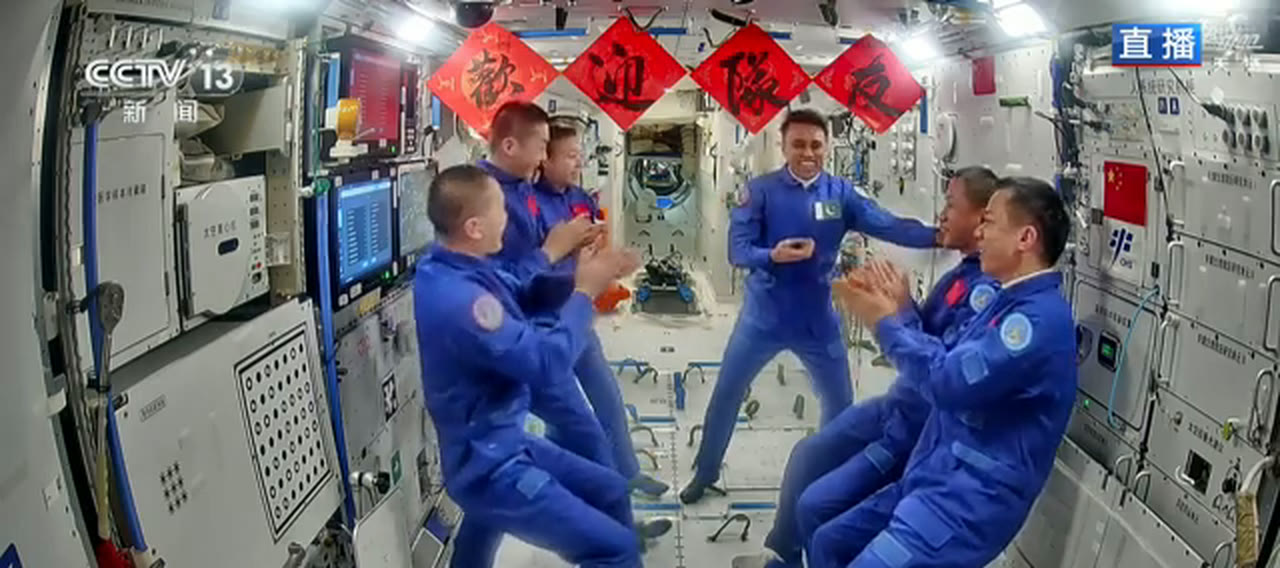
“As the first Pakistani astronaut in space, and the first foreign member to enter the China Space Station, I am very excited. China Space Station — here I come! To be able to reach this altitude, I feel very proud. A twenty-year dream has now come true. I am very happy to see old friends. In the coming days we will work together in space, and I will work hard on every task.
Li Jiaying then brought out small space cakes she had baked for the newcomers — porridge and bread were served too — and the six astronauts posed for the traditional group photograph, chanting together: “The China Space Station is always worth looking forward to!”
The interview: what everyone wanted to know
While the pictures came down from orbit, CMG reporter Liu Jie, at the Beijing Aerospace Flight Control Center, put the public’s questions to Zhao Jing of the China Astronaut Research and Training Center. Here is that exchange.
Q: How are the astronauts feeling at this very moment?
A: “All three astronauts are in excellent condition, including the first-time flyers. During the rendezvous and docking process, their operations were smooth, fluid and highly proficient. The three of them coordinated very well, and they are fully prepared for this ninth in-orbit crew handover.”
Q: The station is welcoming a foreign astronaut for the first time. What support will the ground team provide to help the Pakistani astronaut adapt to working and living in space as quickly as possible?
A: “We conducted comprehensive training on the ground, including fluid redistribution training and various operational drills. We also provided full-scale simulation in the space station simulator, covering key procedures and precautions, such as limiting head movements, to help him maintain his best physical condition. The Shenzhou-23 crew will also help them control their posture and attitude, ensuring they are in the best state to complete the rendezvous and the subsequent tasks.”
Q: The China Space Station uses an all-Chinese interface, and ground-to-space communications are also in Chinese. How long did the Pakistani astronaut spend learning Chinese, and how fluently can he communicate now?
A: “His training time, from the moment he entered the China Astronaut Center, was seven months of Chinese — starting from the very basics. We first provided him with Chinese–English reference charts for all the primary control buttons and major labels in the orbital module, helping him memorise and practise pronunciation. In the process, we transitioned from fully English instruction to bilingual teaching, guiding him to gradually adapt to the Chinese environment. Ali has a very strong ability to pick up the language, and basic communication for work and daily life is not a problem for him now.”
Q: Regarding the Pakistani astronaut’s dietary habits, has the ground team customised any space food specifically for him?
A: “Yes, we have provided him with personalised items, including specialty foods from his home country of Pakistan. We trust that they will be able to enjoy a taste of home while in space. Only with good nutrition can he have the energy to complete all tasks; we have considered every aspect.”
Q: Everyone is very concerned about Zhu Yangzhu, who will be conducting a one-year stay in orbit, where the challenges of doubling the time are far greater than just double. What physiological, psychological and medical support has been prepared?
A: “Zhu Yangzhu facing the challenge of a one-year stay is a first for China’s manned spaceflight programme. We first conducted a scientific evaluation, and through this determined that Zhu Yangzhu currently possesses the ability to extend his stay in orbit. Later, we will continue his health monitoring, including psychological support, and we uploaded instructional videos to provide him with comprehensive physical and technical support.”
Q: Will the data collected over this one-year period lay a solid foundation for long-term space station operations, future manned lunar landings and even deep space exploration?
A: “This flight data will certainly be invaluable, and we will conduct an in-depth analysis. But as this data comes from one person, we objectively assess that while it provides a good reference, we still need to accumulate more samples.”
What happens next
The six astronauts will live and work together for a short handover period. Then the paths split: Ali returns to Earth aboard the Shenzhou-23 spacecraft after about a week aboard; Tang Hongbo and Wu Yi settle in for a stay of about six months; and Zhu Yangzhu remains behind, beginning the first one-year mission in Chinese spaceflight history.
For Pakistan, though, the enduring image is simpler: a fighter pilot from home, floating through a hatch 400 kilometres above the Earth, into the arms of waiting friends — the first Pakistani in orbit, and the first guest ever welcomed aboard Tiangong.
Reporting based on CCTV’s live broadcast of the Shenzhou-24 crew’s arrival at the China Space Station, 25 November 2026.
For more stories like this, subscribe to STORIX with FAYS on YouTube and visit our Videos gallery.
Comments