

News
Why Is Gold Falling? The Real Story Behind the Crash — and How Long It Can Last
In January, gold touched $5,400 an ounce for the first time in history. This week the same ounce changed hands near $3,559. STORIX went looking for a real explanation.
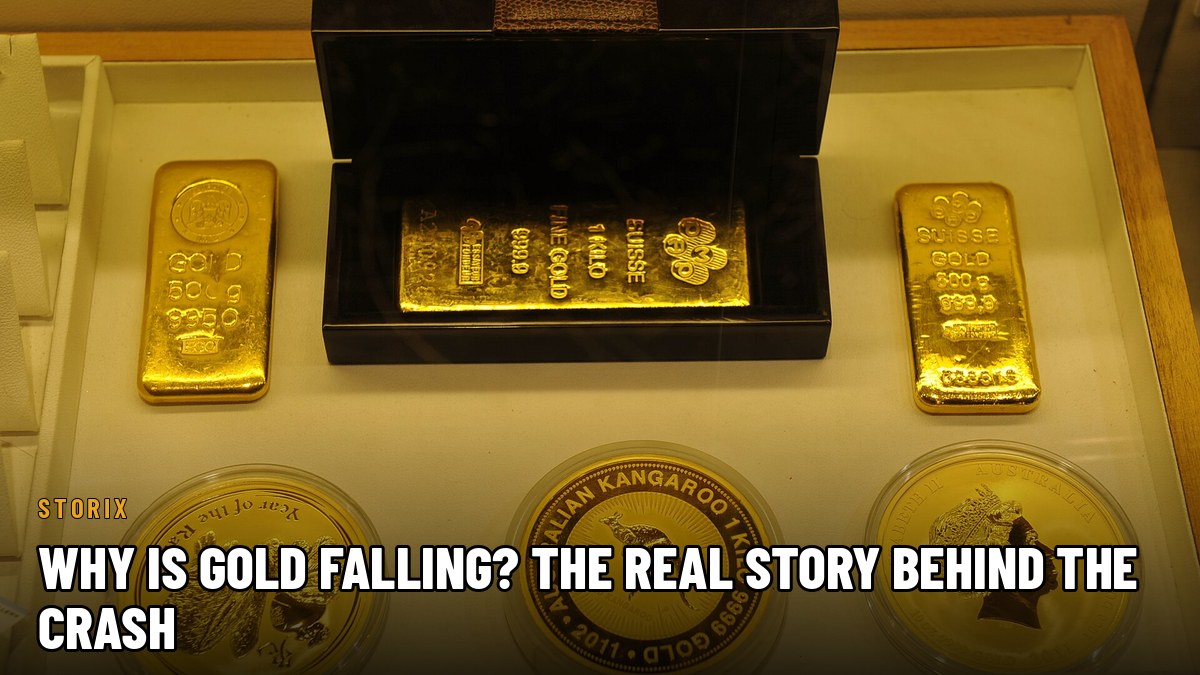
The speed of the fall is as shocking as its size. From the peak of $4,140 on 9 November, gold shed about 14% in just nine trading sessions. Silver, usually gold's quieter partner, fell even harder — between 17% and 29% over the same stretches, depending on the week you measure. Pakistan felt every tremor: the bazaar rate that once touched nearly Rs 432,529 per tola now sits at an official Rs 376,336 per tola. Four separate forces pushed gold off the cliff at the same time. Here they are, one by one.
Reason one: the Fed changed direction
The single biggest blow came from Washington. For two years, gold's great rally fed on the expectation that America's central bank, the Federal Reserve, would keep cutting interest rates. That story has now flipped on its head. Markets are pricing in roughly a 97% probability that the Fed will raise rates by 25 basis points in December, according to the CME FedWatch tool — and one Fed governor, Christopher Waller, has publicly floated the idea of an even bigger 50-point move.
Why does that hurt gold so badly? Because gold pays no interest. When real yields — what investors actually earn on safe government bonds after inflation — sit near 2.9%, the highest in years, holding a bar of gold means giving up real money every single month. Big funds do that arithmetic coldly, and they sell. Every hawkish word from a Fed official this month landed on gold like another weight on a scale.
Reason two: the dollar's surge
At the same time, the US dollar has gone on a run of its own. The Dollar Index, which measures the greenback against six major currencies, climbed to about 103.8 — a 19-month high, up more than 4% since September. Gold is priced in dollars everywhere on earth, so when the dollar rises, gold automatically becomes more expensive for buyers in rupees, yuan, euros and yen. Their demand cools, and the price slides further. It is a mechanical squeeze, and right now it is squeezing hard.
Reason three: the tech crash's forced selling
The third force has almost nothing to do with gold itself — and that is exactly what makes it dangerous. Since October, technology and artificial-intelligence stocks have been sliding as investors question the hundreds of billions being poured into AI with little profit to show for it yet. When leveraged investors lose heavily on stocks, their brokers demand cash immediately — the dreaded margin call. To raise that cash fast, they sell whatever is liquid and sitting on a profit. After a two-year bull run, that asset was gold.
Analysts cited by market researchers, including Goldman Sachs, say thin liquidity made every wave of this forced selling hit harder than it should have. The pattern, veterans note, looks eerily like March 2020, when a similar scramble for cash dragged gold down with everything else — before it rebounded violently once the panic passed.
Reason four: a crowded trade unwinds
Finally, there is the crowd itself. Gold's two-year climb attracted everyone — including, crucially, the very same investors who owned the tech stocks. When a trade becomes that crowded, the exit door is always too small. Profit-booking after January's record added steady selling pressure all year, and once the price started falling in earnest, holders who had bought gold as a "safe" asset discovered it could fall 14% in nine sessions — and rushed for the same door.
How long can this go on?
“This is not a routine dip. It is a crash, and it deserves a real explanation.
Here honesty matters more than drama: nobody knows the exact day a crash ends, and anyone who promises you one is guessing. What analysts watching this market say is more measured. In the near term, they warn, gold remains vulnerable. The slide through the closely watched $3,600 level has, in their assessment, raised the risk of a further drop toward $3,500. The turn, when it comes, will most likely be decided by two things: what the Fed actually does in December, and whether the dollar's surge finally cools. A softer Fed or a weaker dollar could change the picture quickly; another hawkish surprise could extend the pain.
What could stop the fall
And yet, underneath the panic, a floor is quietly being built. This week, as prices hit their lows, physical buyers in India and China — the world's two biggest gold-consuming nations — stepped in to buy the dip, drawn by the cheapest rates in over a year. Behind them stands an even bigger buyer that does not panic at all: central banks. The central banks of China, India and Türkiye have continued accumulating gold at an elevated pace, part of a long strategy to diversify reserves away from the dollar. Market researchers who study this flow say the long-term support under gold has bent, but it has not broken.
What it means for Pakistan
For a family in Bahawalpur or Karachi, the global story lands at the sarafa counter. You can check today's Pakistan rate in our daily report — but the lesson of this crash is bigger than one day's number. Gold fell because interest rates, the dollar and a stock-market panic all pulled at once, not because Pakistanis stopped valuing it. If you hold gold for the long term, history suggests crashes inside a bull market are violent but survivable. If you were waiting to buy, the analysts' warning cuts both ways: cheaper can always get cheaper first. This article is information, not financial advice — your money, your decision.
So tell us: is this crash a trap, or the buying chance of the decade? Have your say in the comments.
Sources: Market reporting by Reuters as carried by GoldSilver and Fast Company; analysis from XTB and Hang Seng research; CME FedWatch rate probabilities. Figures are world-market prices for November 2026; analyst views are attributed opinions, not guarantees.
For more stories like this, subscribe to STORIX with FAYS on YouTube and visit our Videos gallery.
Comments